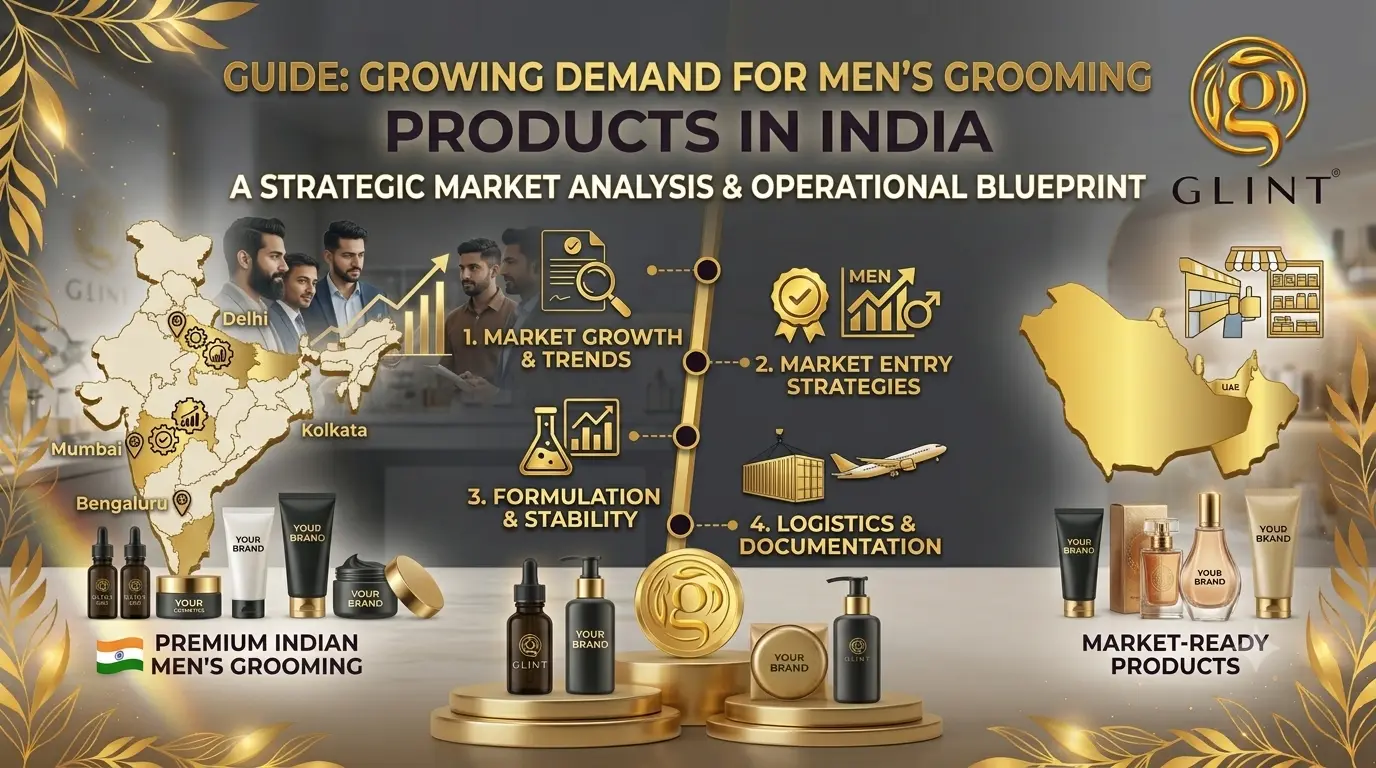
Men's grooming in India has changed dramatically over the past decade.
What was once largely associated with shaving, deodorants and basic hair care has evolved into a much broader personal-care and self-care category.
Today, Indian men are increasingly exploring:
- Face washes
- Moisturisers
- Sunscreens
- Serums
- Beard oils
- Beard washes
- Hair styling products
- Shampoos
- Body washes
- Deodorants
- Aftershave products
- Anti-ageing skincare
- Intimate care
- Fragrances
- Specialised grooming products
The market is no longer limited to traditional shaving products.
According to Euromonitor, India's men's grooming market recorded 9% value growth in 2025, reaching approximately ₹186.3 billion in retail sales.
Another 2026 market analysis estimates India's male grooming products market at approximately USD 2.62 billion in 2026, with continued growth expected through 2034.
This changing consumer behaviour is creating opportunities not only for established brands but also for startups and entrepreneurs looking to launch their own men's grooming products in India.
Why Is Men's Grooming Growing in India?
Several factors are contributing to the rapid expansion of the category.
1. Grooming Is Becoming Part of Everyday Self-Care
Men's grooming is increasingly moving from occasional grooming to daily personal care.
Men are becoming more comfortable using products that were traditionally marketed primarily toward women, particularly in skincare.
A basic routine might now include:
Face Wash → Moisturiser → Sunscreen
while a more advanced routine may include:
Cleanser → Toner → Serum → Moisturiser → Sunscreen
This doesn't mean every consumer follows a complex routine. Instead, it reflects a broader change: men are becoming more aware of skin health, appearance and personal wellness.
The India Brand Equity Foundation describes men's grooming as shifting from a function-led category toward a lifestyle-driven market influenced by social media, e-commerce, changing social norms and younger consumers.
2. Younger Consumers Are Driving Category Expansion
India has a large young consumer base, and younger men are generally more exposed to international beauty and grooming trends.
Social media platforms have made products and routines easier to discover.
Men can now watch:
- Skincare tutorials
- Beard-care routines
- Hair-styling tutorials
- Product reviews
- Grooming tips
- Celebrity routines
- Fitness and wellness content
This has helped normalise conversations around men's personal care.
As a result, grooming is increasingly associated with:
Confidence + Appearance + Lifestyle + Self-Expression
rather than simply hygiene.
3. Social Media Is Changing How Men Discover Products
Instagram, YouTube and other digital platforms have significantly changed beauty-product discovery.
A consumer may see a skincare routine in a short video, search for the product online and purchase it within minutes.
This is particularly useful for emerging grooming brands.
Instead of depending entirely on traditional advertising, a brand can build an audience through:
- Educational videos
- Influencer marketing
- Product demonstrations
- Before-and-after content where appropriate
- Ingredient education
- Grooming tutorials
- Customer reviews
- Expert-led content
This creates opportunities for smaller brands to compete with established companies.
4. E-Commerce Has Removed Many Barriers to Purchase
E-commerce is another major driver.
Men can now access a much wider selection of grooming products than what may be available in a traditional local store.
The convenience of online shopping also makes it easier to discover specialised products.
The India Brand Equity Foundation estimates that e-commerce accounts for around 30–35% of men's grooming sales in urban India, while other market research identifies online stores as one of the fastest-growing distribution channels.
For a new brand, this means a product can potentially reach consumers across India without immediately building a large physical retail network.
5. Men's Grooming Is Expanding Beyond Shaving
Shaving remains an important part of men's grooming, but the category has become much broader.
Today's consumer may be interested in:
Skincare
- Face wash
- Moisturiser
- Serum
- Sunscreen
- Face scrub
- Anti-ageing products
Beard Care
- Beard oil
- Beard balm
- Beard wash
- Beard conditioner
- Beard styling products
Hair Care
- Shampoo
- Conditioner
- Hair oil
- Hair styling products
- Hair creams
Body Care
- Body wash
- Deodorant
- Body lotion
- Fragrance
Shaving
- Shaving cream
- Shaving foam
- Aftershave
- Pre-shave products
Intimate Care
- Men's intimate wash
- Men's intimate hygiene products
- Specialised personal-care products
This expansion gives brands numerous opportunities to create specialised product lines.
6. Men's Skincare Is Becoming a Major Opportunity
One of the biggest changes in men's grooming is the increasing acceptance of skincare.
Mintel's 2026 India men's grooming report highlights growing awareness of skincare among male consumers and identifies specialised skincare and age-specific solutions as important opportunities.
This creates opportunities for products addressing concerns such as:
- Oily skin
- Dry skin
- Uneven-looking skin
- Dullness
- Pollution-related concerns
- Shaving-related skin discomfort
- Signs of ageing
- Sun exposure
For manufacturers, this creates demand for more sophisticated formulations rather than generic products marketed simply as "men's face wash."
7. Beard Care Is Creating a New Product Ecosystem
The growth of facial-hair styles has also created opportunities beyond traditional shaving.
Men with beards may use several specialised products, including:
Beard Wash
↓
Beard Oil
↓
Beard Balm
↓
Beard Styling Product
This creates a complete routine around beard maintenance.
Mintel specifically identifies beard care as an important opportunity in India, while noting that the category still has room for greater product innovation.
For brands, this means beard care can be positioned as an independent product category rather than simply an extension of shaving.
8. Premiumisation Is Creating Opportunities for New Brands
Men's grooming is also becoming more premium.
Consumers are increasingly willing to consider products that offer:
- Better packaging
- Specialised formulations
- Premium ingredients
- Better product experience
- Targeted solutions
- More sophisticated branding
Recent industry reporting also highlights premiumisation as a major direction across India's personal-care market.
For a new brand, this means competing solely on low price may not be the best strategy.
Instead, brands can build value around:
Formula + Experience + Packaging + Education + Brand Identity
9. D2C Brands Are Reshaping Men's Grooming
The rise of direct-to-consumer brands has significantly changed the competitive landscape.
A new brand can now:
- Develop a product
- Build a website
- Create social-media content
- Partner with influencers
- Sell through marketplaces
- Collect customer feedback
- Improve the product
- Expand the range
This makes it possible to build a specialised grooming brand without starting with a massive retail network.
Established companies are also paying attention to the opportunity. Marico, for example, has been expanding its premium personal-care portfolio, including digital-first brands such as Beardo.
10. Tier-2 and Tier-3 Cities Are Becoming Important
Men's grooming is no longer restricted to major metropolitan areas.
Growing internet access, e-commerce and digital content are helping brands reach consumers beyond India's largest cities.
The broader market is increasingly reaching:
- Tier-1 cities
- Tier-2 cities
- Tier-3 cities
This creates a significant opportunity for brands that can combine attractive products with efficient online distribution.
For manufacturers, it also means there is potential to build products designed for a pan-India audience, rather than targeting only metropolitan consumers.
What Men's Grooming Products Are in Demand?
The exact demand varies by consumer segment, but several categories offer strong opportunities.
Men's Face Care
Men's skincare is becoming increasingly specialised.
Potential products include:
- Face wash
- Moisturiser
- Serum
- Sunscreen
- Face scrub
- Face mask
- Anti-ageing cream
Beard Care
Beard grooming provides opportunities for specialised product ranges.
Potential products include:
- Beard oil
- Beard balm
- Beard wash
- Beard conditioner
- Beard styling cream
Men's Hair Care
Haircare remains an important part of grooming.
Brands can explore:
- Shampoo
- Conditioner
- Hair oil
- Hair serum
- Hair cream
- Styling products
Men's Body Care
Body care is another category with significant room for expansion.
Potential products include:
- Body wash
- Body lotion
- Deodorant
- Scrubs
- Fragrance products
Men's Intimate Care
Intimate care is an emerging opportunity within men's personal care.
Products can include:
- Men's intimate wash
- Foaming intimate wash
- Anti-chafing products
- Other specialised hygiene products
For brands interested in this segment, developing a specialised men's intimate care product line can provide an opportunity to differentiate from traditional grooming brands.
Why Launch a Private Label Men's Grooming Brand?
Entrepreneurs don't necessarily need to build their own manufacturing facility to enter the market.
A private label men's grooming manufacturer can provide the infrastructure required to develop and manufacture products under your own brand.
Instead of investing in:
- Manufacturing machinery
- Production facilities
- Large R&D teams
- Quality-control infrastructure
- Raw-material sourcing
- Packaging production
- Warehousing
a brand can work with an established manufacturing partner.
The typical process can look like:
Brand Concept
↓
Product Selection
↓
Formula Development
↓
Sample Development
↓
Testing & Quality Review
↓
Packaging
↓
Commercial Manufacturing
↓
Brand Launch
This allows the entrepreneur to focus on branding, marketing, sales and distribution.
How to Start Your Own Men's Grooming Brand
Step 1: Identify Your Target Consumer
Don't try to sell to every man.
Define your audience.
For example:
- College-age consumers
- Young professionals
- Beard enthusiasts
- Fitness-focused men
- Premium skincare consumers
- Men with sensitive skin
- Mature consumers
- Budget-conscious consumers
A specific audience makes it easier to create relevant products.
Step 2: Select Your Product Category
You can begin with one hero product.
For example:
Beard Brand → Beard Oil
or
Men's Skincare Brand → Face Wash
or
Premium Grooming Brand → Face Wash + Moisturiser
or
Men's Personal Care Brand → Body Wash + Deodorant
Starting with a focused range can make inventory and marketing easier to manage.
Step 3: Find a Reliable Men's Grooming Manufacturer
The manufacturer you choose can have a major impact on product quality and scalability.
Look for a manufacturing partner with:
- R&D capabilities
- Experienced formulation teams
- Quality-control processes
- Appropriate manufacturing standards
- Product testing capabilities
- Packaging support
- Regulatory knowledge
- Private-label experience
- Scalable production
A low manufacturing price should not be the only deciding factor.
Step 4: Develop the Formula
Work with the manufacturer's R&D team to determine:
- Ingredients
- Texture
- Fragrance
- Product performance
- Packaging compatibility
- Target consumer
- Product positioning
A strong formulation should support the brand's positioning rather than simply copy an existing product.
Step 5: Create Your Packaging
Men's grooming packaging has become an important part of product differentiation.
Depending on the target audience, you might choose:
Minimalist
Clean and modern packaging.
Premium
Sophisticated packaging designed for a higher price point.
Sporty
Designed around fitness and active lifestyles.
Natural
Focused on ingredient-conscious consumers.
Packaging should also communicate product information clearly and comply with applicable requirements.
Step 6: Build Your Brand Story
Consumers don't only buy formulas.
They buy brands.
Ask:
Why does this brand exist?
Perhaps your brand is focused on:
- Simplifying men's skincare
- Premium beard care
- Natural personal care
- Active lifestyle grooming
- Affordable premium grooming
- Sensitive-skin solutions
A clear positioning makes marketing significantly easier.
Step 7: Build an E-Commerce Strategy
Your website should make purchasing simple.
Important elements include:
- Product descriptions
- Ingredient information
- Usage instructions
- FAQs
- Product benefits
- Reviews
- Shipping information
- Customer support
You can also sell through established marketplaces.
The objective is to make product discovery and purchasing as frictionless as possible.
Step 8: Invest in Content Marketing
Men's grooming provides excellent opportunities for educational SEO content.
For example:
Skincare Topics
- How to Build a Skincare Routine for Men
- Face Wash vs Cleanser for Men
- Why Men Should Use Sunscreen
- How to Choose a Moisturiser for Men
Beard Topics
- How to Build a Beard Care Routine
- Beard Oil vs Beard Balm
- How to Maintain a Long Beard
- How Often Should You Use Beard Oil?
Haircare Topics
- How to Choose Shampoo for Men
- Men's Haircare Routine
- How to Style Short Hair
- Men's Haircare Mistakes to Avoid
This content can attract organic traffic while educating potential customers.
What Makes a Successful Men's Grooming Brand?
The growing market doesn't mean every new brand will succeed.
Successful brands need differentiation.
1. Strong Product
The product needs to deliver a good experience.
2. Clear Positioning
Consumers should immediately understand what makes the brand different.
3. Good Packaging
Packaging needs to communicate quality and fit the target audience.
4. Education
Consumers need useful information, especially when introducing new product categories.
5. Consistent Quality
Repeat purchases depend heavily on consistency.
6. Smart Distribution
Use a combination of D2C, marketplaces, retail and other suitable channels.
7. Customer Trust
Clear communication and responsible claims are essential for long-term brand building.
Why Quality Matters in Men's Grooming
As consumers become more knowledgeable, they are increasingly interested in what is actually inside their products.
A men's grooming manufacturer should therefore pay attention to:
- Raw-material quality
- Formulation consistency
- Manufacturing hygiene
- Quality control
- Stability
- Packaging compatibility
- Batch consistency
- Product documentation
This is particularly important when developing products for sensitive skin or specialised grooming needs.
A brand may attract its first customer through advertising.
Quality is what can help bring that customer back.
Why Choose Glint Cosmetics for Men's Grooming Manufacturing?
For brands planning to enter India's growing men's grooming market, choosing the right manufacturing partner can simplify the product-development process.
**Glint Cosmetics** provides private label and contract manufacturing solutions across beauty and personal-care categories.
Its manufacturing capabilities cover areas such as:
- Product development
- R&D
- Custom formulation
- Quality control
- Packaging
- Manufacturing
- Warehousing
- Logistics
Glint's broader product portfolio also covers categories such as skincare, haircare, personal care, intimate care and baby care, allowing brands to expand their product range as they grow.
For businesses planning a men's grooming range, working with a manufacturer that can support multiple personal-care categories can make future expansion easier.
You can explore **Glint Cosmetics** to learn more about its manufacturing capabilities and product categories.
Questions to Ask a Men's Grooming Products Manufacturer
Before selecting a manufacturer, ask:
Can you develop custom formulations?
Custom formulations can help differentiate your products.
What are your minimum order quantities?
This is particularly important for startups.
Do you have an in-house R&D team?
R&D capabilities can make product development faster and more flexible.
What quality-control processes do you follow?
Understand how raw materials, production batches and finished products are evaluated.
Can you support packaging?
A manufacturer that can support packaging can simplify the supply chain.
Can you manufacture multiple product categories?
This can help when your brand expands.
Can you support exports?
If international expansion is part of your long-term strategy, ask about export experience and documentation.
Can you scale production?
Your manufacturing partner should be able to support increased volumes as your brand grows.
Men's Grooming and the Opportunity for Product Innovation
The future of men's grooming isn't simply about creating more products.
It's about creating better-targeted products.
For example:
Instead of a generic moisturiser:
Moisturiser for Men With Oily Skin
Instead of a generic beard oil:
Lightweight Beard Oil for Long Beards
Instead of a generic face wash:
Daily Face Cleanser for Urban Men's Skin
Instead of a generic body wash:
Post-Workout Body Wash for Men
Specific positioning can help a brand stand out in an increasingly crowded market.
The Future of Men's Grooming in India
India's men's grooming market is entering a new phase.
The category is moving:
From Shaving → To Grooming
From Grooming → To Skincare
From Skincare → To Self-Care
From Basic Products → To Specialised Solutions
From Traditional Retail → To Omnichannel & D2C
Euromonitor reported 9% value growth in India's men's grooming market in 2025, while current industry analysis points to continued expansion across skincare, beard care, toiletries and other specialised categories.
The opportunity is particularly interesting for brands that can combine:
Good Formulation + Clear Positioning + Attractive Packaging + Digital Marketing + Reliable Manufacturing
Frequently Asked Questions
Is men's grooming a growing market in India?
Yes. Euromonitor reported 9% value growth for men's grooming in India in 2025, with retail sales reaching approximately ₹186.3 billion.
What men's grooming products are popular?
The category includes shaving products, skincare, haircare, beard care, deodorants, fragrances, body care and specialised grooming products.
Is men's skincare growing in India?
Yes. Industry research highlights increasing awareness of skincare among Indian men, with specialised and age-specific skincare representing important growth opportunities.
Can I start my own men's grooming brand?
Yes. Entrepreneurs can use private-label or contract manufacturing to develop products without establishing their own manufacturing facility.
What is private label men's grooming?
Private label men's grooming allows a brand to sell products under its own brand name while an established manufacturer develops and/or manufactures the products.
How do I choose a men's grooming manufacturer?
Look for R&D capabilities, manufacturing experience, quality control, testing, regulatory knowledge, packaging support, reasonable MOQs and the ability to scale.
Is beard care a good opportunity?
Beard care remains an important specialised segment, and Mintel identifies further opportunities for innovation and targeted solutions within India's beard-care market.
Can I launch multiple men's grooming products?
Yes. A brand can start with one or two products and gradually build a portfolio covering skincare, beard care, haircare, body care and other grooming categories.
Conclusion
The Indian men's grooming industry is no longer limited to shaving and deodorants.
It has evolved into a broader beauty, personal-care and self-care ecosystem.
Growing skincare awareness, social media, e-commerce, premiumisation, beard culture and changing attitudes toward male self-care are creating opportunities for both established companies and new brands.
For entrepreneurs, this is an ideal time to think beyond a single grooming product and build a focused product portfolio around a clearly defined consumer.
Whether you're interested in men's skincare, beard care, haircare, body care or specialised grooming, the right manufacturing partner can help turn your product concept into a market-ready brand.
**Glint Cosmetics** offers private label and contract manufacturing capabilities across multiple beauty and personal-care categories, providing brands with support from product development and formulation through manufacturing and packaging.
If you're planning to launch your own men's grooming range, start by identifying your target consumer, selecting your hero product and partnering with an experienced men's grooming products manufacturer in India.
The future of men's grooming is moving beyond basic hygiene—and the next generation of brands will be built around specialisation, quality, convenience and consumer trust.