Introduction
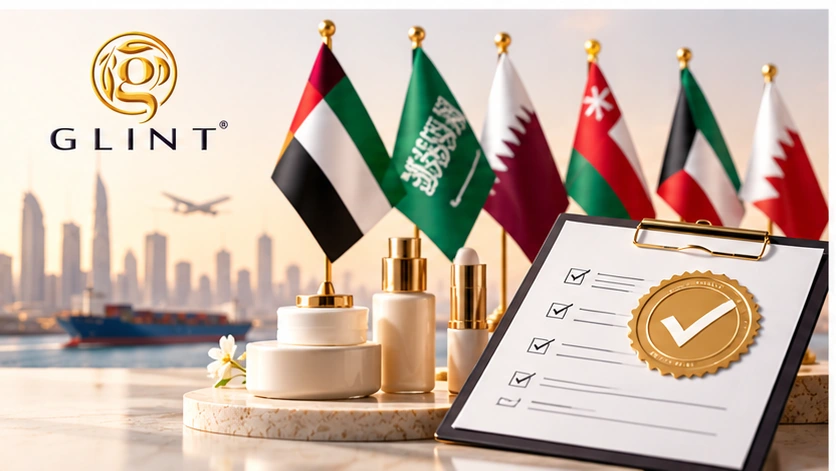
The Gulf Cooperation Council (GCC) is an important export market for cosmetic and personal care products. For Indian manufacturers, private label brands and beauty businesses, countries such as the United Arab Emirates, Saudi Arabia, Qatar, Kuwait, Bahrain and Oman offer opportunities to expand beyond the domestic market.
However, exporting cosmetics involves more than developing an attractive product, choosing suitable packaging and finding an overseas distributor. Products must meet applicable safety, labelling, documentation and market-entry requirements.
This is where GCC cosmetic certification and regulatory compliance become important.
If you are planning to export skincare, haircare, personal care, toiletries or other cosmetic products from India, understanding the regional standards and individual country requirements can help you prepare your products for international markets.
For manufacturers and brands working with a cosmetics manufacturing partner such as Glint Cosmetics, regulatory planning should be considered early in product development rather than left until an export order is ready.
What Does GCC Certification Mean for Cosmetics?
GCC certification is a commonly used term for the standards, conformity assessment and regulatory procedures involved in placing cosmetic products on markets within the Gulf Cooperation Council.
The GCC consists of six countries:
- United Arab Emirates (UAE)
- Saudi Arabia
- Qatar
- Kuwait
- Bahrain
- Oman
The Gulf Standardization Organization (GSO) develops regional standards and technical regulations. For cosmetics, an important reference is GSO 1943:2024, Cosmetic Products – Safety Requirements of Cosmetics and Personal Care Products, which updates the earlier 2021 edition. Its requirements address product safety and related compliance matters. The applicable edition and national implementation should be confirmed for the intended export market. Read the GSO 1943:2024 document.
However, there is an important distinction: meeting a GCC-related standard does not automatically mean that a product is approved for sale in every GCC country. Depending on the destination, businesses may need product registration or notification, conformity documentation, an authorised local representative or importer, and other country-specific formalities.
Why Is GCC Compliance Important for Cosmetic Exports?
1. It Helps Demonstrate Product Safety
Cosmetic products must meet the applicable safety requirements in their intended markets.
Manufacturers should review their formulations against relevant ingredient restrictions and limits, and ensure that supporting safety and quality documentation is available.
Depending on the product, this may involve ingredient assessments, stability studies, microbiological testing, preservative efficacy testing and other relevant evaluations.
A product that complies with requirements in India or another export market should not automatically be assumed to satisfy every GCC requirement without a compliance review.
2. It Supports Market Entry
Regulatory compliance is an important part of preparing products for registration, conformity assessment, customs clearance and commercial distribution.
The exact process depends on the destination country, product category and applicable regulatory route. Saudi Arabia and the UAE, for example, have their own procedures and authorities.
Businesses should confirm the current requirements before finalising packaging, shipping commercial quantities or promising launch dates to distributors.
3. It Builds Distributor and Retailer Confidence
International distributors need confidence that the products they source can satisfy the requirements of their target market.
Organised documentation, consistent product quality, accurate labels and reliable manufacturing records can help make the supplier evaluation process more straightforward.
For Indian private label and contract manufacturers, regulatory preparedness can therefore be an important part of building long-term export relationships.
4. It Helps Reduce Costly Delays
Late-stage formulation changes, label corrections, missing documents or incomplete registration can disrupt an export schedule.
Planning for compliance before production helps identify issues earlier, when changes to formulas, packaging artwork or supporting records may be easier to manage.
Which GCC Standards Are Relevant to Cosmetics?
Several standards and regulatory requirements may be relevant, depending on the product and destination.
GSO 1943: Cosmetic Product Safety
GSO 1943 establishes safety requirements for cosmetics and personal care products. Businesses should review the applicable edition for their target country, including requirements concerning ingredients and product safety.
GSO 2528: Cosmetic Product Claims
Cosmetic marketing claims must be truthful, appropriately supported and consistent with applicable requirements. Claims suggesting a medicinal or therapeutic effect may trigger a different regulatory classification, depending on the product and jurisdiction.
Manufacturers should review claims such as “anti-acne,” “heals damaged skin,” “treats hair loss” or “clinically proven” carefully before printing them on packaging or using them in advertising.
GSO ISO 22716: Good Manufacturing Practices
ISO 22716 provides guidelines for Good Manufacturing Practices (GMP) in cosmetics. These cover areas such as production, quality control, storage and handling.
A manufacturer’s quality systems and available GMP evidence may be relevant to customer assessments and regulatory submissions. However, holding a GMP-related certificate should not be presented as a substitute for product registration or other required approvals.
What Documents May Be Required to Export Cosmetics to GCC Countries?
The required documents vary by destination, product type and regulatory route. An exporter may need to prepare some or all of the following:
| Document or record | Why it matters |
| Full product formula | Supports ingredient and regulatory review |
| Ingredient list using appropriate INCI names | Helps assess formulation and labelling compliance |
| Product safety and testing reports | Supports safety and quality assessment |
| Certificate of Analysis (CoA) | Records relevant specifications and batch results |
| Stability and microbiological test reports | Supports product quality and shelf-life assessment |
| Product label and packaging artwork | Allows review of mandatory information and claims |
| Certificate of Free Sale, where required | May support registration or import procedures |
| Manufacturing and GMP documentation | Supports assessment of manufacturing controls |
| Product registration or notification documents | Demonstrates completion of applicable market-entry formalities |
| Commercial invoice, packing list and shipping documents | Supports the export and customs process |
This list is a planning guide, not a universal checklist. Some documents may not be required for every product, while particular countries or product categories may require additional evidence, declarations or testing.
GCC Cosmetic Export Requirements: UAE vs Saudi Arabia
Although regional standards provide a shared framework, exporters should plan separately for each destination.
Exporting Cosmetics to the UAE
Cosmetic products entering the UAE may be subject to product conformity requirements and registration procedures applicable to the relevant emirate and product category.
Depending on the route, requirements may involve conformity assessment, supporting laboratory reports, product composition details, label artwork and registration with the relevant authority.
Before exporting, businesses should verify the applicable requirements with the UAE Ministry of Industry and Advanced Technology (MoIAT), the relevant local authority and their importer or regulatory representative.
Exporting Cosmetics to Saudi Arabia
Saudi Arabia has its own cosmetics regulatory framework overseen by the Saudi Food and Drug Authority (SFDA).
Depending on the product and shipment, requirements may involve product notification through the relevant SFDA system, compliance with applicable GSO requirements, and conformity documentation for customs clearance.
Exporters should confirm the current process and documentation with the SFDA and an appropriately authorised conformity assessment provider. See the Saudi cosmetics conformity guidance.
What About Qatar, Kuwait, Bahrain and Oman?
These markets also have national procedures and authorities that exporters must consider.
Do not assume that a registration completed for the UAE or Saudi Arabia automatically covers the other GCC countries. Confirm each destination’s requirements, including registration, labelling, importer responsibilities and any conformity assessment obligations, before planning a multi-country launch.
Does GCC Certification Require Arabic Labelling?
Labelling requirements depend on the applicable national rules and product category. Arabic information is an important consideration for many GCC markets, and businesses should confirm whether Arabic-only or bilingual Arabic-English labelling is required for their particular products.
Depending on the market and product, labels may need to include information such as:
- Product name and intended function
- Ingredient list
- Net quantity
- Manufacturer or responsible business details
- Country of origin
- Batch or lot identification
- Instructions for use and relevant warnings
- Shelf-life or date information, where applicable
Claims and other label elements must also comply with the destination country’s requirements.
Practical tip: Have the final label artwork reviewed before printing large packaging quantities. A label designed for the Indian market may need adjustments before it can be used for GCC exports.
Are All Cosmetic Products Subject to the Same Requirements?
No. Requirements can differ according to the product’s intended use, formulation, claims and regulatory classification.
Examples include:
- Skincare: Creams, lotions, serums and moisturisers.
- Haircare: Shampoos, conditioners, hair masks and styling products.
- Personal care: Body washes, deodorants and other personal hygiene products.
- Baby care: Products intended for infants and young children.
- Oral care: Toothpastes and related products, depending on their classification and claims.
- Intimate care: Products that may be subject to specific packaging, safety or other requirements.
A product marketed as a cosmetic may be treated differently if its formulation, intended purpose or claims place it within another regulatory category. Exporters should assess each product individually instead of assuming that a single approval covers an entire product range.
How Indian Cosmetic Manufacturers Can Prepare for GCC Exports
For manufacturers and brands based in India, a structured approach can help reduce avoidable compliance issues.
Step 1: Identify the Target Countries
Decide whether the initial launch will focus on one market, such as the UAE, or multiple GCC countries. Each additional destination may involve separate regulatory work.
Step 2: Review the Product Formula
Check the formula against the applicable requirements, including ingredient restrictions and limits. Ensure that ingredient names, concentrations and supporting documentation are accurate and complete.
Step 3: Plan Product Testing
Determine which safety, stability, microbiological or other tests are relevant to the product and destination. Use suitable laboratories and retain the resulting reports.
Step 4: Finalise Compliant Packaging
Prepare packaging artwork that meets applicable language, ingredient, warning, traceability and claims requirements.
Step 5: Assemble the Technical Documents
Organise formula declarations, product specifications, testing records, manufacturing documentation and any certificates or declarations required for the intended market.
Step 6: Confirm Registration and Import Procedures
Work with the importer, regulatory specialist or relevant conformity assessment provider to establish the required registrations, certificates and customs documentation.
Step 7: Verify Before Shipment
Confirm that the product and shipment meet the requirements applicable at the time of export. Keep records organised and ensure that the documents correspond to the actual formulation, packaging and product being shipped.
How Glint Cosmetics Can Support Your Export Manufacturing Plans
For brands looking to enter international beauty markets, choosing a manufacturing partner involves more than selecting a formula and packaging design.
A reliable partner should understand the importance of product consistency, documentation, quality controls and early regulatory planning.
Glint Cosmetics works in the cosmetics and personal care manufacturing space, serving businesses interested in developing and manufacturing products for their brands.
When evaluating a manufacturing partner for a GCC-focused launch, discuss:
- Custom formulation and product development requirements.
- Product categories and manufacturing capabilities.
- Ingredient documentation and testing support.
- Quality systems and available manufacturing certifications.
- Packaging compatibility and label-development coordination.
- Export documentation and the division of responsibilities between manufacturer, brand owner, importer and regulatory representative.
The exact support available should be confirmed directly with the manufacturer. Product registration and market-specific approvals should be verified for each intended destination rather than assumed to be included in a manufacturing arrangement.
If you are exploring private label or contract manufacturing for a new cosmetics range, visit Glint Cosmetics to learn more about the company and its offerings.
Frequently Asked Questions
1. What is GCC certification for cosmetics?
GCC certification is a broad industry term for the standards, conformity assessments and regulatory procedures associated with selling cosmetics in GCC markets. The exact certificates and registrations required depend on the destination country and product.
2. Is one GCC certificate valid in all six countries?
Not necessarily. Regional standards may be harmonised, but national registration, notification, conformity assessment and import procedures can differ. Verify requirements separately for each country.
3. What is GSO 1943?
GSO 1943 is a Gulf technical regulation covering safety requirements for cosmetics and personal care products. Exporters should check the applicable edition and its implementation in the target country.
4. Is GMP certification mandatory for exporting cosmetics to the GCC?
Manufacturing practices and related evidence may form part of regulatory or customer requirements. Whether a particular certificate is mandatory depends on the destination, product and applicable approval route. Confirm the current requirements rather than assuming that one GMP certificate guarantees market access.
5. Do cosmetics exported to the GCC need Arabic labels?
Arabic labelling requirements depend on the destination and product. Exporters should verify the required languages and mandatory label information before approving packaging artwork.
6. Can an Indian manufacturer export private label cosmetics to GCC countries?
Yes, Indian manufacturers can pursue private label export opportunities, provided the products and export arrangements meet the applicable requirements. The brand owner, manufacturer, importer and regulatory representative should clearly establish who is responsible for documentation, registration and compliance.
7. Does halal certification replace cosmetic product registration?
No. Halal certification, where relevant or commercially requested, does not replace applicable cosmetic safety, conformity assessment, registration or import requirements.
Conclusion
GCC cosmetic certification is an important consideration for Indian beauty brands and manufacturers planning to expand into the Middle East. Understanding GSO standards, product safety, labelling, documentation and country-specific registration requirements can help businesses prepare for market entry more effectively.
The key is to plan compliance early, assess every product individually and verify the requirements of each destination before production and shipment.
For brands exploring cosmetic and personal care manufacturing, Glint Cosmetics is a starting point for learning about manufacturing options and discussing product development requirements.
Disclaimer: This article is for general informational and educational purposes only and is not regulatory, legal or export advice. Requirements may change and can vary by country, product category and intended claims. Confirm current requirements with the relevant authorities and qualified regulatory professionals before exporting.