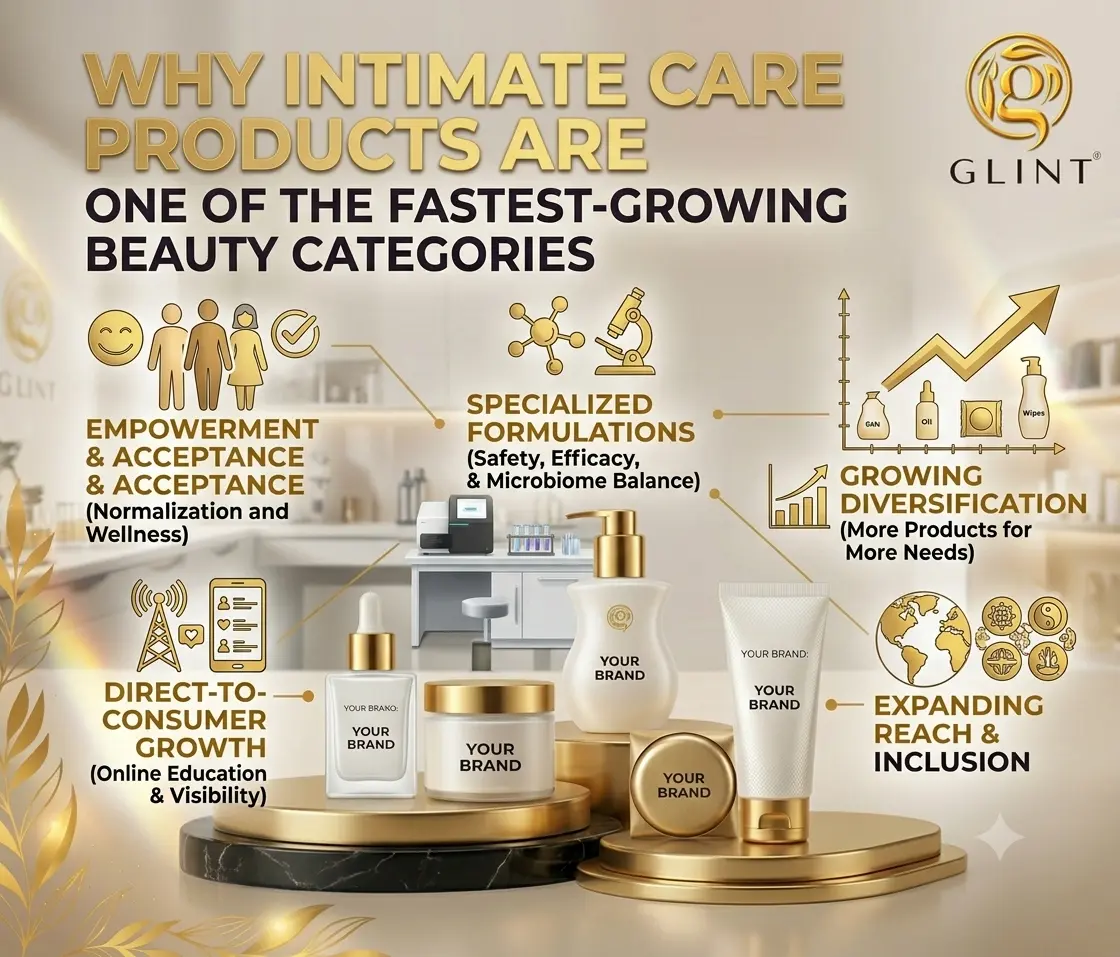
The beauty industry is constantly evolving.
For decades, consumers primarily associated beauty with products such as skincare, haircare, makeup and fragrances. Today, that definition is becoming much broader. Personal care is increasingly being viewed as part of everyday self-care, hygiene, comfort and wellness.
One category benefiting from this shift is intimate care.
Products such as intimate washes, wipes, anti-chafing creams, soothing products and men’s intimate hygiene solutions are gaining greater visibility as consumers become more comfortable discussing personal hygiene and looking for products specifically designed for sensitive areas.
Recent market research also points toward continued growth in India’s intimate-care segment, with premium, natural and specialised products attracting increasing interest.
For cosmetic brands and entrepreneurs, this creates an interesting opportunity: intimate care is moving from a relatively niche category toward a more mainstream personal-care segment.
And for brands considering launching products in this space, choosing an experienced intimate care products manufacturer in India can be an important part of the process.
What Is Intimate Care?
Intimate care generally refers to products designed specifically for hygiene, comfort and care of the external intimate area.
Depending on the product and applicable regulations, the category can include:
- Intimate washes
- Intimate wipes
- Anti-chafing creams
- Soothing creams
- Personal lubricants
- Men’s intimate washes
- Hair-removal products
- Feminine hygiene-related products
- Other specialised personal-care products
The category is broader than feminine hygiene alone.
There is growing room for products designed for women, men and different lifestyle needs, giving brands opportunities to develop more specialised product ranges.
For example, Glint Cosmetics’ current intimate-care portfolio includes intimate wash, intimate wet wipes, anti-chafing & rash cream, men’s foaming wash, men’s intimate wash, lubricants, hair-removal cream and toilet-seat sanitizer.
1. Consumers Are Becoming More Comfortable Talking About Intimate Hygiene
One of the biggest changes in the category is cultural.
Topics that were previously considered uncomfortable or embarrassing are increasingly being discussed through:
- Social media
- Digital health platforms
- E-commerce
- Women’s health communities
- Beauty influencers
- Educational content
- Healthcare professionals
- D2C brands
This creates an environment where consumers can research products privately before purchasing them.
The result is a shift from:
“I don’t need a product specifically for this.”
toward:
“Is there a product designed specifically for this need?”
That change in consumer mindset is important for category growth.
2. Intimate Care Is Becoming Part of the Broader Self-Care Trend
Beauty and personal care are increasingly moving toward holistic self-care.
Consumers aren’t only interested in looking good.
They are also interested in:
- Feeling comfortable
- Maintaining hygiene
- Skin health
- Personal wellness
- Daily routines
- Preventive care
- Personalised products
This trend is affecting many categories, from skincare to body care—and intimate care fits naturally into this broader movement.
Recent reporting on the beauty industry highlights the wider transition from traditional beauty products toward everyday self-care and personal wellness. (The Times of India)
This creates an opportunity for intimate care to become a regular part of consumers’ personal-care routines rather than an occasional purchase.
3. E-Commerce Has Made Intimate Care Easier to Purchase
Privacy is particularly important in intimate care.
Some consumers may feel uncomfortable purchasing certain products from a physical store or discussing their needs with a salesperson.
E-commerce solves part of that problem.
Consumers can:
- Research products privately
- Compare ingredients
- Read reviews
- Check product information
- Order discreetly
- Receive products at home
Market research on India’s broader feminine hygiene category indicates that online retail is one of the fastest-growing distribution channels.
This is particularly relevant for new D2C brands.
A brand doesn’t necessarily need to build a large physical retail network before testing demand.
It can start with:
Website → Marketplace → Social Media → Digital Marketing → Direct Delivery
4. The Category Has Significant Room for Product Innovation
Another reason intimate care is attractive is the opportunity for product innovation.
Brands can differentiate through:
Formulation
Develop products around specific consumer preferences and requirements.
Texture
Create lightweight, refreshing or soothing product experiences.
Ingredients
Explore suitable ingredients and formulation approaches while staying within applicable cosmetic regulations.
Fragrance
Offer appropriately formulated fragrance options or fragrance-free alternatives where suitable.
Packaging
Develop discreet, premium and convenient packaging.
Product Format
Move beyond traditional washes into wipes, creams, gels and other formats.
This creates opportunities for brands to build a portfolio rather than relying on a single SKU.
5. Premiumisation Is Creating New Opportunities
Consumers are increasingly willing to pay more for products that provide a better experience or address a specific need.
This trend can be seen across India’s beauty and personal-care industry.
Euromonitor data cited in a 2026 market report indicates that India’s premium beauty and personal-care segment achieved 15% growth in 2025, reaching INR 132.2 billion in retail sales value.
For intimate care brands, premiumisation can involve:
- Better packaging
- Sophisticated formulations
- Ingredient transparency
- Sensitive-skin positioning
- Dermatologically evaluated products
- Sustainable packaging
- Premium fragrances or fragrance-free options
- Specialised products for different consumer groups
The opportunity is not necessarily to make the most expensive product.
It is to create a product where the consumer understands why it provides additional value.
6. Natural and Ingredient-Conscious Products Are Gaining Attention
Ingredient awareness has become a major trend throughout beauty and personal care.
Consumers increasingly ask:
What’s inside the product?
This has encouraged brands to communicate more clearly about:
- Ingredients
- Formulation philosophy
- Skin compatibility
- Product testing
- Manufacturing standards
- Sustainability
In intimate care, this can be particularly important because the products are designed for sensitive areas.
However, brands should be careful about making unsupported claims.
A cosmetic product should not be marketed as treating or preventing a medical condition unless the product is appropriately regulated for that purpose.
For brands, responsible product education can therefore be more valuable than exaggerated marketing.
7. Women’s Intimate Care Is Expanding Beyond Traditional Hygiene
Historically, much of the category focused on basic feminine hygiene.
Today, the opportunity is broader.
Consumers are looking at products related to:
- Everyday freshness
- Comfort
- Sensitive-skin care
- Chafing
- Hair removal
- Post-workout care
- Travel
- Personal hygiene
- Lifestyle convenience
This creates opportunities for brands to build specialised product ranges.
Market research also indicates that feminine intimate-care products in India are moving beyond traditional categories, with washes and other specialised formats forming part of the expanding market.
8. Men’s Intimate Care Is an Emerging Opportunity
One of the most interesting opportunities is men’s intimate care.
Men’s grooming has already expanded significantly beyond traditional shaving products.
Today’s men’s personal-care consumer can find products for:
- Face care
- Haircare
- Beard care
- Body care
- Deodorants
- Skin care
- Intimate hygiene
Yet men’s intimate care remains comparatively less developed as a dedicated beauty category.
That creates potential white space for brands.
Glint Cosmetics currently lists both men’s intimate wash and men’s foaming wash among its intimate-care manufacturing portfolio.
For existing men’s grooming brands, intimate care can therefore become a logical extension of the product range.
9. Intimate Care Offers Strong Opportunities for D2C Brands
D2C brands are particularly well positioned to develop intimate-care products.
Why?
Because the category often benefits from:
Education + Privacy + Convenience + Repeat Purchase
A D2C brand can educate customers through:
- Blogs
- Videos
- Social media
- Product guides
- FAQs
- Expert-led content
Then provide a private purchasing experience.
This creates a strong relationship between content marketing and product sales.
For example, a brand could publish educational content around intimate hygiene and then introduce a relevant product range.
The key is to educate rather than create fear.
10. Repeat Purchases Can Support Long-Term Brand Growth
Many intimate-care products are consumable.
Unlike a one-time beauty purchase, products such as washes, wipes and creams may need to be repurchased regularly.
This can create opportunities for:
- Subscription models
- Replenishment reminders
- Bundles
- Multi-packs
- Product routines
- Cross-selling
For a brand, repeat purchasing can potentially improve customer lifetime value.
However, the product must first provide a genuinely good customer experience.
Repeat purchase should come from trust and satisfaction—not unnecessary fear-based marketing.
11. The Category Can Support Multiple Price Segments
Intimate care does not have to be positioned exclusively as luxury.
Brands can create products across different price points:
Mass Market
Affordable, accessible products designed for everyday use.
Mid-Premium
Better packaging, specialised formulations and stronger brand positioning.
Premium
Sophisticated formulations, premium packaging and highly differentiated brand experiences.
D2C Specialty
Products targeting specific consumer groups or lifestyle needs.
This allows entrepreneurs to choose positioning based on their target audience.
12. There Is an Opportunity for Private Label Intimate Care
One of the biggest advantages for entrepreneurs is that they don’t necessarily need to build their own cosmetic manufacturing facility.
They can work with a private label intimate care manufacturer.
The manufacturer can potentially support:
Product Concept
↓
Formulation
↓
Sampling
↓
Testing
↓
Packaging
↓
Manufacturing
↓
Quality Control
↓
Finished Product
This allows a brand to concentrate on:
- Branding
- Marketing
- Distribution
- E-commerce
- Customer acquisition
while the manufacturing partner manages the technical production process.
Glint Cosmetics provides private label and third-party intimate-care manufacturing and currently lists nine intimate-care formulations in its portfolio.
13. Intimate Care Can Be an Extension of Existing Beauty Brands
You don’t necessarily have to launch an intimate-care brand from scratch.
Existing brands can extend their portfolio.
For example:
Skincare Brand
Face Care → Body Care → Intimate Care
Women’s Wellness Brand
Feminine Hygiene → Intimate Care → Personal Wellness
Men’s Grooming Brand
Beard Care → Body Care → Men’s Intimate Care
Personal Care Brand
Body Wash → Deodorant → Intimate Hygiene
This can be a relatively logical category extension when the brand already has consumer trust.
14. Packaging and Discretion Matter
Intimate-care products require a different approach to packaging than many traditional beauty products.
Consumers may prefer packaging that is:
- Discreet
- Clean
- Premium
- Easy to carry
- Easy to use
- Leak-resistant
- Convenient for travel
Packaging can also become an important brand differentiator.
A product doesn’t necessarily need provocative imagery to stand out.
In many cases, a clean, professional and educational brand identity can create greater trust.
15. Education Is One of the Biggest Marketing Opportunities
The intimate-care category has an interesting challenge:
Consumers may have questions but hesitate to ask them.
That makes educational content extremely valuable.
Brands can create content around topics such as:
- What is intimate care?
- How does intimate hygiene differ from regular body care?
- What should consumers consider when choosing an intimate wash?
- Why is pH relevant?
- How should an intimate-care product be used?
- What ingredients should consumers understand?
- How should intimate-care products be stored?
- When should someone consult a healthcare professional?
This content can build trust while also improving organic search visibility.
The goal should be:
Educate → Build Trust → Introduce Product → Encourage Informed Purchase
rather than:
Create Fear → Sell Product
16. Intimate Care Is Becoming More Inclusive
Another growth opportunity is the development of products for different demographics and lifestyles.
Potential segments include:
- Women
- Men
- Young adults
- Active consumers
- Frequent travellers
- Fitness consumers
- Sensitive-skin consumers
- Premium personal-care users
This allows brands to move from generic “intimate hygiene” positioning toward more targeted products.
For example:
Men’s Intimate Wash
is a much more specific proposition than simply:
Personal Hygiene Product
The more precisely a product solves a legitimate consumer need, the easier it can be to build differentiated positioning.
17. India Offers an Attractive Environment for New Intimate-Care Brands
India’s overall beauty and personal-care industry continues to expand.
Euromonitor reported that India’s mass beauty and personal-care market grew 9% in 2025, reaching approximately INR 1.3 trillion in retail value.
Within that broader market, intimate care remains a comparatively specialised category.
This combination creates an interesting environment for:
- Startups
- D2C brands
- Existing personal-care companies
- Women’s wellness brands
- Men’s grooming brands
- Retailers
- International brands sourcing from India
What Intimate Care Products Can Brands Manufacture?
Depending on the manufacturer’s capabilities and applicable regulations, brands can explore products such as:
Feminine Intimate Care
- Intimate washes
- Intimate wipes
- Anti-chafing products
- Soothing products
- Personal lubricants
Men’s Intimate Care
- Men’s intimate wash
- Men’s foaming wash
- Grooming products
Supporting Personal Care
- Hair-removal creams
- Hygiene products
- Travel hygiene products
Glint Cosmetics currently lists nine intimate-care products/formulations, including intimate wash, wipes, anti-chafing/rash cream, lubricants and men’s intimate-care products.
Why Choose Glint Cosmetics for Intimate Care Manufacturing?
For brands interested in entering this category, finding the right manufacturing partner is important.
Glint Cosmetics provides private label, white label and contract manufacturing services across beauty and personal-care categories.
Its intimate-care portfolio currently includes:
- Anti-Chafing & Rash Cream
- Hair Removal Cream
- Intimate Wash
- Intimate Wet Wipes
- Lubricants
- Men’s Foaming Wash
- Men’s Intimate Wash
- Toilet Seat Sanitizer
- Toner
Glint also states that it provides in-house R&D, formulation design, quality control, regulatory affairs, packaging, production, warehousing and logistics, allowing brands to develop products through an end-to-end manufacturing process.
For entrepreneurs interested in launching their own intimate-care range, explore Glint’s intimate care manufacturing portfolio.
You can also explore its private label manufacturing services for a broader range of cosmetic and personal-care products.
How to Launch a Private Label Intimate Care Brand
Launching an intimate-care brand can be approached in several stages.
Step 1: Identify the Consumer
Determine exactly who you want to serve.
Step 2: Research the Market
Understand competitors, pricing, product formats and consumer needs.
Step 3: Choose Your Product
Start with one or a small number of clearly defined SKUs.
Step 4: Select a Manufacturer
Choose a manufacturer experienced in intimate-care formulation and production.
Step 5: Develop the Formula
Work with the manufacturer’s R&D team to finalise the product.
Step 6: Test Samples
Evaluate texture, fragrance, packaging and overall product experience.
Step 7: Finalise Packaging
Create discreet, functional and brand-appropriate packaging.
Step 8: Review Regulatory Requirements
Ensure the product, claims, ingredients and labelling meet applicable regulations.
Step 9: Manufacture
Move into commercial production after approvals.
Step 10: Launch
Use D2C, marketplaces, retail or distribution channels.
Step 11: Build Education
Create useful content that answers consumer questions.
Step 12: Expand the Range
Once the first products gain traction, introduce complementary SKUs.
What Makes a Successful Intimate Care Brand?
The strongest opportunities aren’t necessarily about launching the most products.
They are about solving a specific consumer problem well.
A successful intimate-care brand should focus on:
Trust
Consumers need confidence in the manufacturer and formulation.
Safety
Products intended for sensitive areas require careful formulation and quality control.
Education
Explain what the product is and how it should be used.
Discretion
Packaging and purchasing should make customers comfortable.
Transparency
Communicate ingredients and product information clearly.
Differentiation
Have a reason for consumers to choose your product over alternatives.
Consistency
Maintain product quality from batch to batch.
The Future of Intimate Care
The intimate-care category is benefiting from several broader changes happening throughout beauty and personal care:
More Awareness
↓
Less Stigma
↓
More Online Education
↓
Greater E-Commerce Access
↓
Product Innovation
↓
Premiumisation
↓
More Specialised Brands
The category is therefore increasingly moving from a niche hygiene segment toward a broader personal-care and self-care opportunity.
Market research published in 2026 describes India’s intimate-care market as transitioning toward a more mainstream consumer-goods category, while other research highlights growth opportunities in specialised products and online purchasing.
Frequently Asked Questions
Are intimate care products a growing beauty category?
Yes. Intimate care is gaining visibility as consumers increasingly view personal hygiene and specialised care as part of broader self-care. Market research indicates continued growth in India’s intimate-care segment.
What are the most popular intimate care products?
Products can include intimate washes, wipes, anti-chafing products, soothing products and other specialised personal-care formats. The exact demand varies by market and consumer segment.
Is intimate care only for women?
No. The category increasingly includes products specifically designed for men as well as women.
Can I start my own intimate care brand?
Yes. Entrepreneurs can work with a private label or contract manufacturer to develop and manufacture products under their own brand.
Is intimate care profitable for a new brand?
The category can offer opportunities because many products are consumable and can support repeat purchases. However, profitability depends on formulation costs, MOQ, pricing, distribution, customer acquisition and product-market fit.
Can an existing skincare brand add intimate care products?
Yes. Intimate care can be a logical extension for skincare, personal-care, women’s wellness and men’s grooming brands.
What should I look for in an intimate care manufacturer?
Look for strong R&D, appropriate manufacturing standards, product testing, regulatory knowledge, packaging capabilities, quality control and experience with intimate-care formulations.
Conclusion: Why Intimate Care Is an Opportunity for Beauty Brands
Intimate care is becoming an increasingly interesting category because it sits at the intersection of beauty, personal care, hygiene, wellness and self-care.
Consumers are becoming more comfortable discussing intimate hygiene, e-commerce has made private purchasing easier, and brands have more opportunities to create specialised products for different audiences.
For entrepreneurs, the category offers opportunities across:
Feminine Care + Men’s Care + D2C + Private Label + Premium Personal Care + E-Commerce
The opportunity, however, is not simply to launch another intimate wash.
The brands most likely to stand out will be those that combine safe formulations, clear education, appropriate claims, thoughtful packaging, strong quality control and genuine consumer value.
For businesses looking to enter this growing category, working with an experienced private label intimate care products manufacturer in India can make product development and manufacturing significantly easier.
Glint Cosmetics offers intimate-care manufacturing alongside skincare, haircare, baby care and personal-care solutions, with in-house R&D, quality control, packaging and manufacturing capabilities.
Ready to develop your own intimate-care product line? Explore Glint Cosmetics’ intimate care manufacturing solutions and discover how your product idea can be developed into a market-ready private label product.